MyLifeInARepo
Project Overview
- Role
- Solo build
- Timeline
- May 2026 - June 2026
- Stack
- Status
- Mostly done — occasional contributions
What I worked on
A personal life-tracking system built as a git repo of daily markdown files, parsed into structured data and rendered through a Next.js dashboard. On top of that sits a financial module — net worth, budgeting, and cash-flow forecasting — fed by a bank-statement import pipeline and a transaction-categorization engine modeled on how Monarch Money handles rule-based categorization.
The Challenge
The hard part was turning freeform daily markdown notes into reliable structured data — parsing something written to be human-readable into something a dashboard could trust, without forcing the writing into a rigid schema.
The process
Daily markdown schema
Settled the shape of a daily note — human-readable first, still parseable.
Parser to structured data
Turned freeform notes into reliable structured records the app could query.
Next.js dashboard
The surface that renders the parsed life data back as something legible.
Financial module
Net worth, budgeting, and cash-flow forecasting on top of the same data model.
Bank-statement import
A pipeline to pull real transactions in from statements.
Categorization engine
Rule-based transaction categorization modeled on Monarch Money.

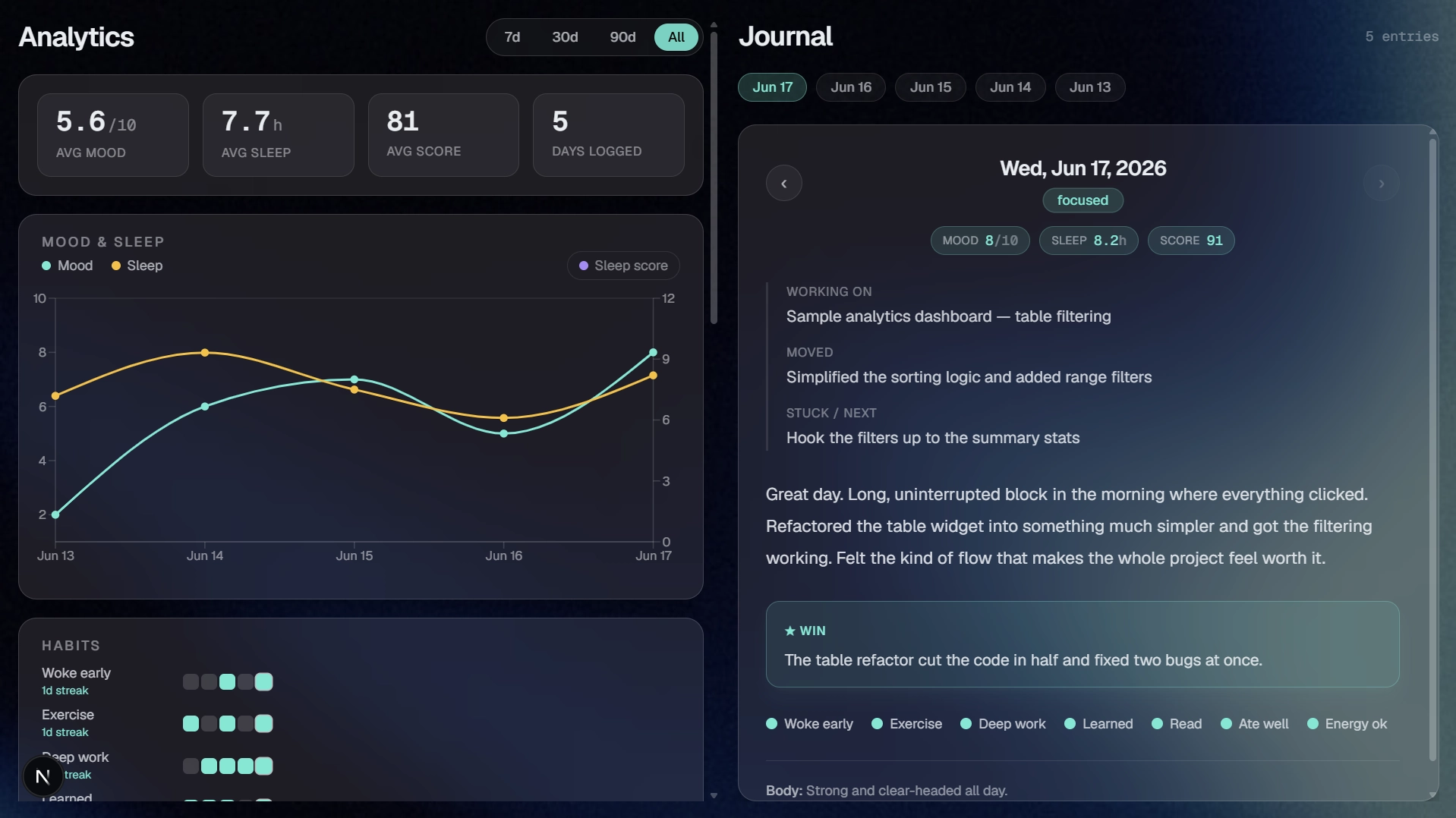
MyLifeInARepo started from a simple idea: keep the record of a life the way you'd keep a codebase. Every day is a markdown file, committed to a git repo — a plain-text log you can read on its own, with the full history that git gives you for free. The app parses those files into structured data and renders them through a Next.js dashboard.
The whole trick was turning freeform daily notes into structured data reliable enough to build on.
The interesting problem sat between those two forms. A daily note is written to be human-readable, not machine-readable, and the whole point was to keep it that way — so the parser had to pull reliable structured data out of freeform writing without turning the journal into a form. Get that wrong and every downstream view inherits the noise.
On top of the parsed data sits a financial module — net worth, budgeting, and cash-flow forecasting — fed by a bank-statement import pipeline and a rule-based categorization engine modeled on how Monarch Money handles it. It's mostly done now; I still contribute to it occasionally.